 ExplainThisDoc
Letter from the Ausländerbehörde: what it means and what to do
A letter from the “Ausländerbehörde” (the immigration office) usually arrives for one of three reasons: your “Aufenthaltstitel” (residence permit) is about to expire or you have applied for something, the office needs documents or information from you, or it has made a decision. Almost every such letter is in German and most contain a date by which you must act. This guide explains who writes to you in Germany, what the common types of letter mean, how renewal and the “Fiktionsbescheinigung” work and where to get free help. One short section covers Austria and Switzerland.
Who is writing to you, and what kind of letter it is
This section covers Germany; for Austria and Switzerland see section 6. In Germany, the Ausländerbehörde handles residence matters under the Residence Act (“Aufenthaltsgesetz”, § 71 AufenthG). Each federal state organises it differently, so the name on the letterhead varies: in Berlin it is the “Landesamt für Einwanderung (LEA)”, in Munich the “Servicestelle für Zuwanderung und Einbürgerung”. Letters about your permit, an appointment, missing documents or a decision come from this office. The BAMF (Federal Office for Migration and Refugees) writes about integration and job-related language courses, migration advice and entry bans after an asylum procedure (the asylum procedure itself is not covered here).
Most letters fall into a few types. The deadline that applies is always the one in your letter.
| Type of letter | What it means | What you must do | By when |
|---|---|---|---|
| Invitation or summons (“Einladung zur Vorsprache”, “Ladung”) | The office wants to see you in person, for example to check documents or take fingerprints. Such an order can be enforced (§ 82 (4) AufenthG). | Go, with every document listed in the letter. | The date and time in the letter. |
| Request to cooperate (“Aufforderung zur Mitwirkung”, § 82 AufenthG) | You have a duty to cooperate (“Mitwirkungspflicht”): facts and proof in your favour must be presented without delay. | Send exactly what is asked and keep proof of when you sent it. Proof handed in late “can be disregarded”. | The deadline in the letter. |
| Hearing (“Anhörung”, § 28 VwVfG) | The office intends a decision against you, such as a refusal or revocation, and must first let you comment. | Respond in writing with supporting documents; get advice now. | The deadline in the letter. |
| Formal decision (“Bescheid”) | A written decision with reasons: refusal, conditions, revocation, expulsion or an entry and residence ban. It contains a “Rechtsbehelfsbelehrung” (instructions on legal remedies). | Read the instructions first. Depending on the state you go straight to the administrative court with a “Klage”, or file an objection (“Widerspruch”) first. | One month from notification (§ 74 and § 70 VwGO). If the instructions are missing or wrong, one year (§ 58 VwGO); still act within a month if you can. |
| Fee notice (“Gebührenbescheid”) | The fee for a permit or certificate under the Residence Ordinance (AufenthV). | Pay as instructed, or show current proof of exemption such as an SGB II, SGB XII or AsylbLG benefits notice. | The payment date in the notice; at the latest when you collect your card. |
| Request to leave (“Ausreiseaufforderung”) with threat of removal (“Abschiebungsandrohung”) | You no longer have a right to stay and must leave by a set date; voluntary departure is normally seven to 30 days (§ 59 AufenthG). | Take the letter to an advice centre or a lawyer at once and check the remedy deadline. | The departure date; for the remedy, the deadline in the instructions. |
If your permit is for training or work and that ends early, tell the office within two weeks (§ 82 (6) AufenthG).
When does a deadline start? An ordinary letter counts as notified on the fourth day after it was posted (§ 41 (2) VwVfG); if it arrived later, the office must prove delivery. Decisions with a deadline often come by “Postzustellungsurkunde” (delivery with a formal record): a letter put in your mailbox counts as delivered at that moment, and the postal worker writes the date on the envelope (§ 180 ZPO); a letter left at the post office counts as delivered with the notice in your mailbox, and you have three months to collect it. Keep the envelope: it shows when your deadline started.
Renewing your residence permit: apply before it expires
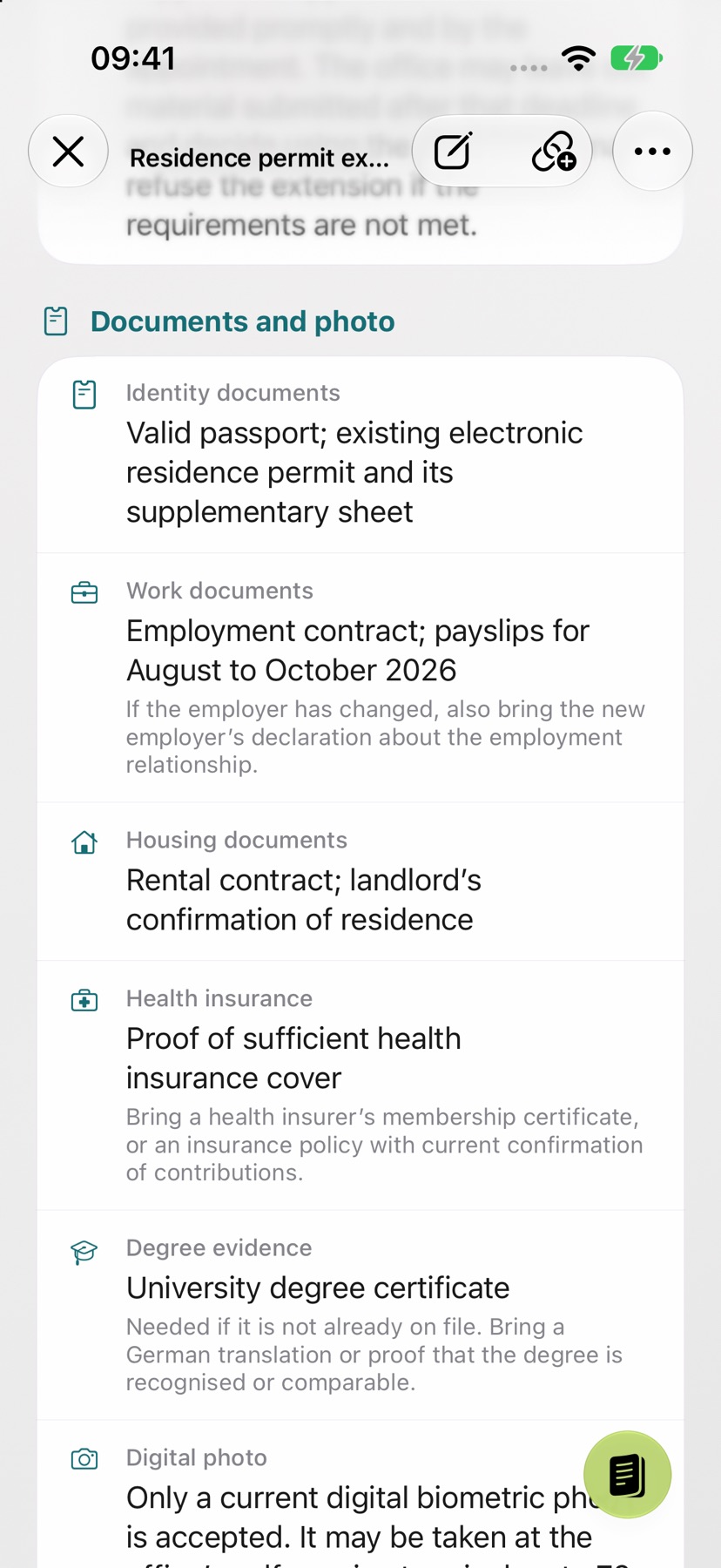
The most important rule in Germany: apply for the extension before your permit expires. Then your current permit is deemed to continue until the office decides (§ 81 (4) AufenthG), with all its conditions, including the permission to work. Hamburg recommends applying about eight weeks before expiry. Bring everything the letter lists: typically a valid passport, your current card, a biometric photo (digital since 1 May 2025; €6 at the terminal in Berlin), proof of your purpose such as a work contract and the last three pay slips or your enrolment, health insurance, proof of income, your rental agreement or registration certificate, and birth or marriage certificates with sworn translations.
The Fiktionsbescheinigung is the certificate the office must issue to show that your application is pending (§ 81 (5) AufenthG). It counts only together with a valid passport. Check which legal basis is ticked. With the § 81 (4) version your old permit continues, so you can keep working and, as Berlin’s LEA explains, travel abroad and re-enter. The § 81 (3) version, issued when you were staying lawfully without a permit (for example visa-free), allows neither re-entry nor taking up work. It costs €13 (€6.50 for minors), free with SGB II, SGB XII or AsylbLG benefits. If you urgently need proof of your status, Berlin’s LEA helps once you prove the emergency.
If you apply late, nothing continues automatically: the office “may” order the continuation to avoid undue hardship, a discretionary decision, not a right (§ 81 (4) sentence 3). So apply on time and keep proof of the date your application arrived.
Collecting the eAT. Permits are issued as an electronic residence permit (“eAT”), a card with a chip. The Bundesdruckerei usually needs two to four weeks. Bring your passport, your old permit and the PIN letter (a representative needs a written power of attorney and their own ID); unpaid fees are due at collection at the latest.
| Fee | Amount |
|---|---|
| Residence permit, first issue (§ 45 AufenthV) | €100 |
| Extension by up to three months / by more than three months | €96 / €93 |
| Change of purpose, including extension | €98 |
| Settlement permit (“Niederlassungserlaubnis”, § 44) | €113 (€124 self-employed, €147 highly qualified) |
| EU long-term residence permit (§ 44a) | €109 |
| Fiktionsbescheinigung (§ 47 (1) no. 8) | €13 |
| New eAT after loss, passport expiry, data change or chip defect (§ 45c) | €67 (free if a chip defect is not your fault) |
| Express procedure (§ 45a) | €35 on top |
Minors pay half. If you cannot support yourself without SGB II, SGB XII or AsylbLG benefits, you are exempt from certain fees (§ 53 AufenthV); bring a current benefits notice. If your application is refused, the fee is still charged (§ 49).
From Ukraine: § 24 permits and the dates that matter
If you hold a residence permit for temporary protection under § 24 AufenthG, renewal is largely automatic. Germany’s continuation regulation (UkraineAufenthFGV, last amended on 22 October 2025) says: permits under § 24 (1) held by Ukrainian nationals that were valid on 1 February 2026 continue to apply, including their conditions, until 4 March 2027 without an individual extension. According to the federal portal no visit to the Ausländerbehörde is needed. For stateless people and non-Ukrainian nationals the continuation applies only if they had protection status in Ukraine on 24 February 2022, are family members of such a person, or held a permanent Ukrainian residence permit.
At EU level, temporary protection was extended by Implementing Decision (EU) 2026/1912 of 30 July 2026 to 4 March 2028, applying from 5 March 2027, with a condition that Ukrainian military-service obligations have been complied with, except for people who already had protection by 30 July 2026 and kept it. The German Interior Ministry announced on 23 September 2026 that protection in Germany is extended until the end of 4 March 2028 and that the condition concerns only men who newly entered the EU since 5 August 2026. Please note: as of 8 November 2026, the German regulation that continues existing permits automatically still named 4 March 2027. How your card will be continued beyond that date will be published on germany4ukraine.de; check there as the date approaches.
For new arrivals, people who were in Ukraine on 24 February 2022 and enter Germany by 4 December 2027 need no residence permit for 90 days from first entry (UkraineAufenthÜV, as amended on 30 September 2026); apply for the § 24 permit within those 90 days. People who enter from 9 October 2026 onwards and are subject to Ukrainian military-service obligations are excluded unless they prove compliance. Under § 24 (5) AufenthG you must live where you were assigned, and for three years after a first permit in the assigned federal state (§ 12a), unless you have a job subject to social insurance of at least 15 hours a week, training or study.
Official language, integration course and your long-term status
German is the official language of the procedure (§ 23 VwVfG). The office may demand a translation, in justified cases a sworn one, at your cost; the submission still counts as received on the day it arrived if the translation follows within the deadline. You can ask for the operative part of a decision and its Rechtsbehelfsbelehrung to be translated free of charge into a language you understand (§ 77 (3) AufenthG).
Integration course. You must attend if you are entitled to a course and cannot communicate in German at least in a simple way, if you receive SGB II benefits and the job centre requires it, or if you have a particular need for integration (§ 44a AufenthG). The language part has 600 lessons. You pay half the cost rate unless exempt on application, and you get 50 percent back if you pass within two years. Not attending affects the extension of your permit and a later settlement permit.
Settlement permit (§ 9 (2) AufenthG): generally after five years with a residence permit, with a secured livelihood, 60 months of pension contributions, sufficient German and enough living space. Fee: €113.
Naturalisation (§ 10 StAG, version of 8 November 2026): you are entitled after five years of lawful habitual residence if you have a permanent or listed residence permit, support yourself without SGB II or SGB XII benefits (with exceptions), have no criminal convictions, speak German at level B1 and pass the naturalisation test (€25, 33 questions, 17 correct answers in 60 minutes). The three-year fast track no longer exists (abolished 30 October 2025). The fee is €255. Since 27 June 2024 you no longer have to give up your previous citizenship.
Free help in Germany, and fraud patterns to know
You do not have to work through such a letter alone, and good advice is free:
- Migrationsberatung für erwachsene Zuwanderer (MBE): migration advice for adults over 27, run by the welfare associations. Find a centre with the BAMF-NAvI.
- Jugendmigrationsdienste (JMD): for people aged 12 to 27 (jmd4you.de).
- Hotline “Arbeiten und Leben in Deutschland”: +49 30 1815-1111, Monday to Thursday 9–16, Friday 9–12, in German and English.
- Beratungshilfe (legal aid for advice): apply at your local court (“Amtsgericht”) with a statement of your finances. It covers residence law too; your own contribution is €15 and can be waived.
Two fraud patterns are documented by the authorities. Appointment trading: Berlin’s LEA switched off its online booking because commercial providers were buying up appointments to sell them; today the department assigns appointments itself by e-mail, so nobody can legitimately sell you one. Fake websites and payment requests: the federal portal for people from Ukraine states that immigration offices do not demand payments or bank details online. Forged language or integration certificates are a criminal offence.
Austria and Switzerland in brief
Rules differ from Germany. The key points:
| Austria | Switzerland | |
|---|---|---|
| Who writes | Settlement authority at your place of residence; in Vienna the MA 35 (+43 1 4000-3535). | Cantonal “Migrationsamt”; the expiry notice (“Verfallsanzeige”) comes from the SEM. |
| Renewal deadline | Apply before your card expires, at the earliest three months before and at the latest on its last day (§ 24 NAG). Confirmation of filing (“Einreichbestätigung”) covers the wait; a “Notvignette” (€50) allows travel. A late application is treated as a first application. Fee since 1 January 2026: €218. | Apply at the earliest three months and at the latest 14 days before expiry (Art. 59 and 63 VZAE); the notice arrives two to three months before (B, C) or about one month before (L, S). An appointment does not extend the deadline. |
| Typical letters | “Ladung” (summons, § 19 AVG); “Verbesserungsauftrag” (incomplete application: fix it within the deadline or it is rejected, § 13 (3) AVG); “Bescheid”. | “Verfügung” (decision) with reasons; a refusal may come with a “Wegweisung” (order to leave) with seven to 30 days to depart (Art. 64d AIG). |
| Appeal deadline | Complaint (“Beschwerde”) within four weeks of delivery, filed with the issuing authority. A letter after a missed delivery counts as delivered on the first day of the pick-up period (at least two weeks). | Stated in the instructions on remedies and differs by canton. |
| From Ukraine | Per the BFA information sheet of August 2026, residence runs until 4 March 2027 and extends automatically to 4 March 2028; the BFA sends a new “Ausweis für Vertriebene” by registered letter, so report address changes. Advice: Helping Hands Vienna (+43 1 310 88 80 10). | Status S is issued for one year; renew at the earliest three months and at the latest 14 days before expiry. The Federal Council will not lift Status S before 4 March 2027 without a fundamental change. Legal advice: HEKS (+41 44 360 88 00). |
Fraud warning (SEM, May 2026): fake SEM letters announced the withdrawal of residence status as of 31 December 2026; the SEM states that they are forged. Do not scan QR codes in such letters; the SEM never demands payments this way. Report them to [email protected].
Get the letter explained in English with ExplainThisDoc
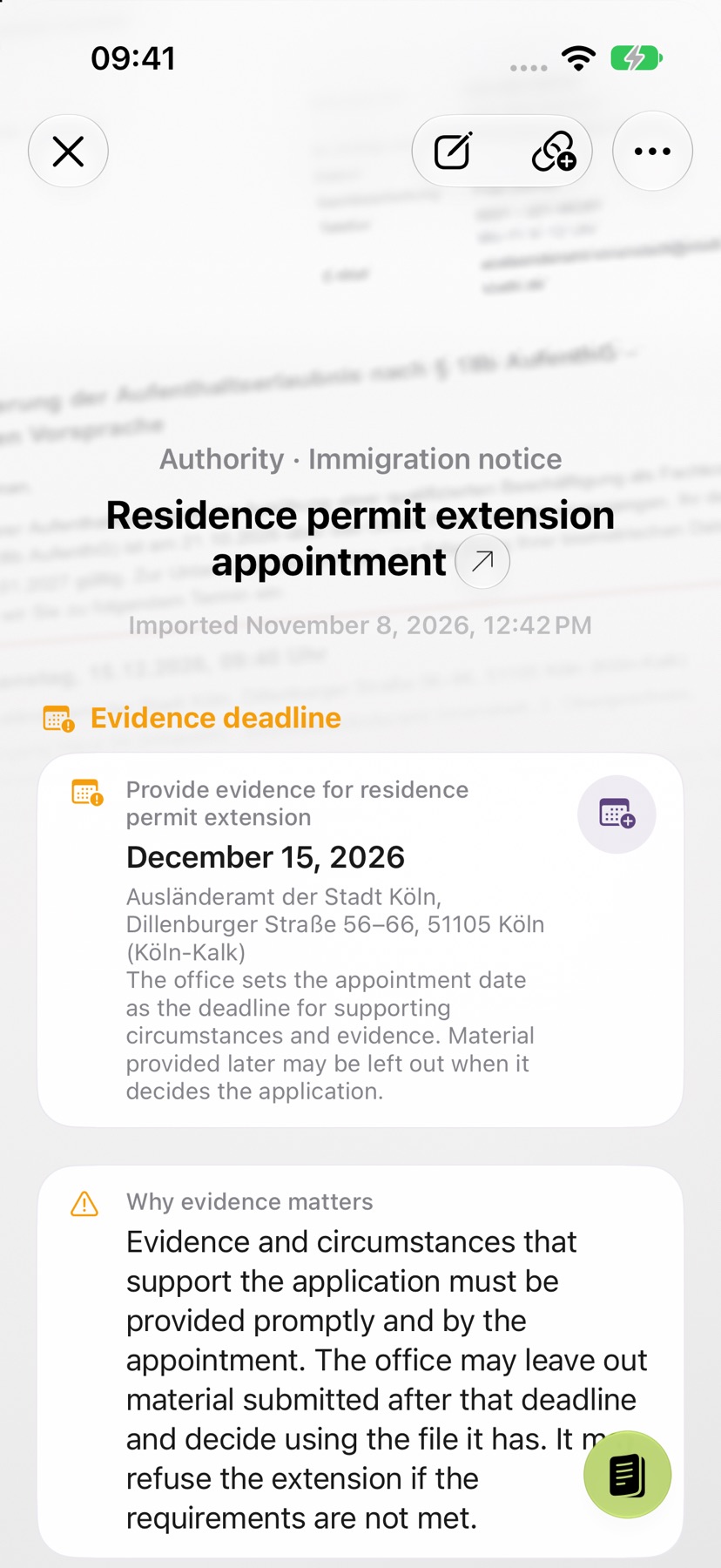
Photograph the letter with “Scan” in ExplainThisDoc, or import the PDF from the office’s e-mail with “Import file”. Text recognition runs on your iPhone, and the explanation appears in your app language, in English even though the letter is in German. The free Light analysis runs with Apple Intelligence on supported devices and in supported languages. Pro explains in more detail which type of letter it is and what the office asks of you, finds the appointment and the deadline and prepares a calendar entry that you check against the letter and save; one Pro analysis costs one credit. Key terms such as Fiktionsbescheinigung can stay in the original, so you can find them on the paper. To compare the recognised text with the letter first, turn on “Show text before explain” under “Settings” → “Text review”.
Write the list of documents to bring as a note on the letter. In your “Archive”, link the letter to your passport scan and current permit, so the previous letter is there when the next one arrives. How calendar entries work is in the guide Add deadlines from documents to your iPhone calendar. The explanation is not legal advice. Check every deadline yourself in the original and on the envelope, and when in doubt ask an advice centre before the deadline.
Get your letter from the Ausländerbehörde explained
Snap or import
Scan a document or bring in a photo or PDF. No sign-up, no folders.
Understand it in plain words
Light analysis, free on your device¹. In depth with Pro: 1 credit per analysis.
Find it when you need it
The original, the explanation and your notes stay together in your archive.
- No sign-up
- No subscription
- Start right away

 Scan with your iPhone camera
¹ With Apple Intelligence enabled on a supported device and in a supported language.