 ExplainThisDoc
Traffic fine from abroad: is it real, and what to do by when
Six months after a holiday in Italy a letter arrives: a verbale from a town you drove through, in Italian, with an amount and a deadline. Or a Dutch beschikking, a French avis de contravention, a demand from a collection agency you have never heard of. This guide is for people living in Germany, Austria, Switzerland or the Netherlands who get a fine from another country. It explains how a foreign authority gets your address, how to tell a real fine from a scam, which deadlines and discounts apply in Italy, France, the Netherlands, Austria, Switzerland, Spain and Belgium, and what happens at home in Germany, Austria, Switzerland or the Netherlands if you do not pay. Every rule names its country.
Why a fine from another country reaches you months later
If a camera records your car speeding, running a red light or being driven with a mobile phone in use in another EU country, the authority there can ask the vehicle register of the country where the car is registered for the keeper’s name and address. The legal basis is Directive (EU) 2015/413. It covers eight offences, including speeding, no seat belt, running a red light, drink or drug driving, no helmet and illegal mobile phone use. Parking offences, tolls and low-emission zones are not covered; those claims reach you by other routes, for example through a collection agency.
The authority of the country where the offence happened decides whether to pursue it. If it does, it writes to the registered keeper in the language of the vehicle’s registration document. The standard EU form asks you to return a reply form within 60 days if you do not pay, and says the information letter itself has no legal consequences.
Two separate procedures are involved. The fine procedure always runs in the country where the offence happened, under its law: its deadlines, discounts and appeal routes apply, and an appeal has to be lodged there. Enforcement at home begins only when that country formally asks your country of residence for enforcement under Framework Decision 2005/214/JHA; your country may refuse to enforce a fine below €70. Long gaps are normal: Italy may serve a notice on a person living abroad up to 360 days after the offence. The amending Directive (EU) 2024/3237 must be applied by 20 July 2027; it adds ten offences and sets eleven months after the offence as the notification deadline where the keeper was identified automatically. Until then the current rules apply.
What to do, step by step
- Check plausibility. Were you, or your car, at that place at that time? Compare the notice with your travel dates and rental contract. If it is plausible, the claim is often justified: do not pay hastily, but do not ignore it.
- Verify the sender independently. Find the authority’s website and phone number yourself and compare case number, amount and account; do not use contact details or links from the letter.
- Find the deadline and the day it starts in the table under “Country of the offence” and write the date down. Pro finds the payment or appeal deadline in your letter and prepares a calendar entry that you check against the original and save. For a BfJ hearing letter in Germany it is two weeks from receipt.
- Decide: pay with the discount, or contest. Payment counts as accepting the fine. A contest goes to the country of the offence, in its language and through its route: the Prefetto in Italy, the ANTAI in France, the officier van justitie in the Netherlands, alegaciones to the DGT in Spain, the issuing authority for an Austrian Strafverfügung.
- If you were not driving, say so there. Name the driver in the country of the offence: in France by désignation, in Spain within 20 days, in Switzerland to the authority that imposed the fine; in the Netherlands raise it in your appeal. In Italy the owner is released only if the car was used against the owner’s will. If you could have raised this abroad, the BfJ in Germany will not consider it later.
- Pay only by the route in the official letter, with the reference exactly as printed. In the BfJ procedure you pay the Bundeskasse only after the decision, not on receipt of the hearing letter.
- Keep your evidence: parking tickets, payment receipts, the rental contract, photos. Whoever can prove they paid need not react to a ticket sent later (Chamber of Labour Styria).
Is it real? A quick check before you pay
Genuine fines follow fixed patterns. The Dutch CJIB publishes a checklist for fines from abroad.
- Authority and case number: the issuing authority is named with its address and usually its website, and the letter carries a file number (verbale number in Italy, telepayment number in France, 16-digit CJIB number in the Netherlands, PV number in Belgium).
- Your plate and the facts: registration number, make and model, place, date and time, the rule broken with its legal article, the amount.
- Your rights and how it arrives: how to pay, how to object or name the driver, and by when. A fine comes by post; the CJIB states it is never sent by e-mail.
- Payment route: a bank transfer with an exact reference, or an official portal such as amendes.gouv.fr (France), fines.justonweb.be (Belgium) or the DGT’s electronic office (Spain). No official procedure asks for gift cards, cryptocurrency or card details through a link in a text message.
What the authorities themselves say:
| Country | Official statement or documented scam |
|---|---|
| France | The ANTAI never sends text messages; fines are paid only on amendes.gouv.fr. Fake “INFO ANTAI” messages about €35 lead to a card form (November 2026). |
| Netherlands | The CJIB never e-mails, texts or messages about a fine; real claims show in the Digitaal Loket (DigiD). Thousands of fake-fine reports in March 2026. |
| Spain | The DGT never notifies fines by e-mail. INCIBE warned in September 2026 of fake “last reminder before surcharge” messages. |
| Austria | Fines and toll claims never come by text message. Genuine on-the-spot notices carry a QR code with IBAN, so check the account and domain. |
| Switzerland | Zurich cantonal police warn of e-mails with invented fine numbers; BACS reported fake QR codes stuck over genuine ones at car parks. |
| Germany | Consumer centres warn of fake parking tickets under the wiper; if in doubt, take the ticket to the police. |
| Belgium | A payment order (bevel tot betalen) always names the account BE34 6792 0036 2590; if you can log in at fines.justonweb.be with the PV number and identification code, the fine is genuine. |
The pattern is the same everywhere: a payment request by text message or e-mail with a link, a small amount, a 24-hour deadline, threats of bailiffs or licence points, card-only payment and a domain that looks almost right. A plausible fine deserves a reply: the absence of warning signs does not make a letter genuine, and the presence of one does not make a real claim go away.
Country of the offence: deadline, discount and what happens if you ignore it
The rules belong to the country where the offence happened, and each counts deadlines differently: from service in Italy, from the printed date in France, from the day after notification in the Netherlands, from the sending date in Belgium, from issue or service in Austria. Amounts are in local currency.
| Country | Deadline and discount | If you ignore it |
|---|---|---|
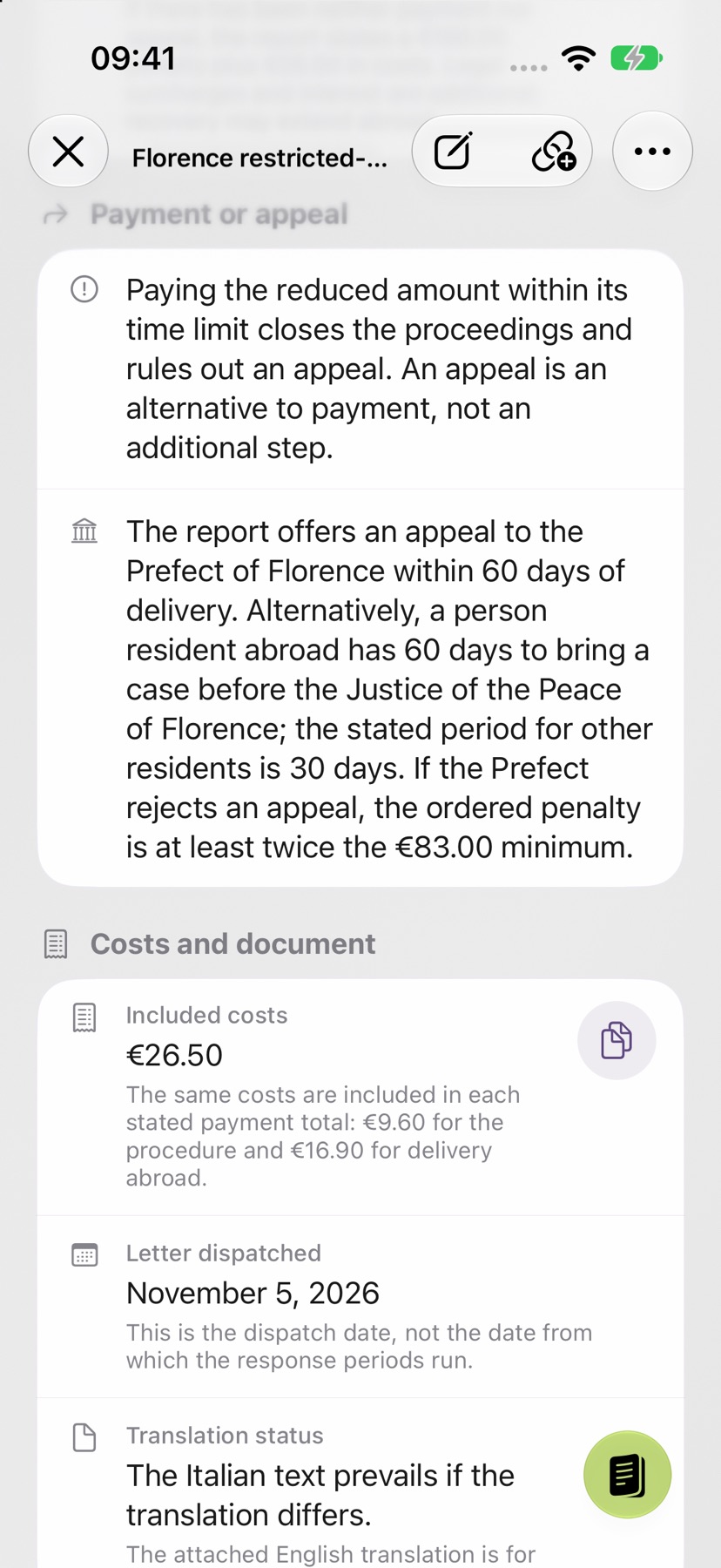
| Italy | Notice must be served on a person abroad within 360 days of the offence; a later notice lapses, but you must raise that yourself. Reduced payment within 60 days of service, a further 30 % off within 5 days (not with seizure or licence withdrawal). Appeal to the Prefetto within 60 days, free, in Italian, unless you already paid. Paying counts as acceptance. | After 60 days the notice becomes an enforceable title for half the statutory maximum plus costs. The owner is jointly liable unless the car was used against their will. A collection agency does not pause the appeal period. |
| France | Deadlines run from the date printed top right of the avis; for notices abroad every deadline is one month longer. Reduced fine: 15 days (cheque/cash) or 30 days (card online/phone). Standard: 45 days (60 online). 4th class: €90 / €135 / €375. Contest within 45 days; camera offences need a deposit first (consignation). Name the driver at usagers.antai.gouv.fr or on the requête en exonération form. | Amende forfaitaire majorée (€375 for 4th class), with 20 % off within 30 days of sending (45 by telepayment). |
| Netherlands | The CJIB issues the beschikking to the keeper within four months of the offence. 8 weeks to pay or agree instalments; Visa/Mastercard via the QR code for residents of DE, AT, BE, LU, FR, PL. Appeal to the officier van justitie within 6 weeks from the day after notification; then the kantonrechter. | Reminder: two more weeks at no cost. Then +50 %, and after another reminder 3 times the fine (€50 becomes €75, then €150). |
| Austria | Anonymverfügung (up to €365): pay within 4 weeks of issue; no appeal. Strafverfügung (up to €600): object within 2 weeks of service. Organstrafverfügung (up to €90): 2 weeks, with the full identification number. Ersatzmaut without vignette (since 1 January 2026): €200 car, €100 motorcycle, 4 weeks. | Unpaid Anonymverfügung becomes a driver inquiry and a Strafverfügung. Unpaid Ersatzmaut becomes an administrative penalty of €300 to €3,000. |
| Switzerland | Ordnungsbusse up to 300 francs (e.g. 60 no seat belt, 100 phone use). Stopped: pay at once or within 30 days. Otherwise the keeper pays within 30 days or names the driver. Non-residents who do not pay on the spot must deposit the amount. | Ordinary criminal proceedings. Fines from €70/80 francs (offences since 1 May 2024) can be enforced in Germany. |
| Spain | Pay within 20 calendar days: fine halved, but you waive alegaciones. Alegaciones: 20 days; recurso de reposición: one month. Identify the driver within 20 days; failing is a very serious offence with a double or triple fine. Pay only via the DGT electronic office, miDGT app, phone or in person. | 45 more days for the full amount, then the AEAT with a 20 % surcharge. Time-barred after four years. |
| Belgium | Immediate collection: pay within 10 days of sending, with the structured reference exactly as printed. Contest at fines.justonweb.be with PV number and identification code. | Reminder: 10 more days. Settlement proposal within 20 days at +33 %, payment order within 30 days of receipt at +35 %. Police court: €55 to €2,750 plus costs. |
Where a discount is offered, paying counts as acknowledging the fine, so after payment there is no appeal in Italy, France or Spain. If you want to contest, do it within the same window.
If you do not pay: how the fine is enforced where you live
Once the procedure abroad is final, the issuing authority can ask your country of residence for enforcement. This guide covers Germany, Austria, Switzerland and the Netherlands.
| Country of residence | Who enforces, and from what amount | Your deadlines and rights |
|---|---|---|
| Germany | The Federal Office of Justice (BfJ) in Bonn, after an EU authority formally requests it. Minimum €70 including costs. Austrian fines follow a bilateral treaty from €25; Swiss fines the 2022 police treaty. | Hearing letter: two weeks from receipt to respond. Then a decision; object within two weeks of service. Payment to the Bundeskasse within two weeks of it becoming final. No points in Flensburg. “I was not driving” counts only if you could not have raised it abroad, and you must raise it with the BfJ. |
| Austria | EU-VStVG; refused under €70 (costs count towards that amount). German fines: 1988 treaty from €25; Swiss and Liechtenstein fines: 2017 treaty from €70 or 100 francs. | The authority must ask you to pay and let you comment. Amounts paid abroad are credited. Do not ignore foreign fines: they can be demanded at a traffic check there. |
| Switzerland | Not bound by the Framework Decision; bilateral treaties with Germany (from €70/80 francs, offences since 1 May 2024), France (since 2009), Austria and Liechtenstein (since 2017, from €70/100 francs). Only money, in francs, capped at the Swiss maximum. | A German request must exclude substitute imprisonment; you must have been heard and able to appeal. |
| Netherlands | The public prosecutor for Noord-Nederland recognises the decision; the CJIB enforces it. May be refused at €70 or less. | A letter marked “Europese boete”; instalments possible. At most two reminders, then a bailiff (you bear the costs). Finally substitute detention with the issuing state’s consent; after serving it you no longer pay. |
Private collection agencies. Italian municipalities in particular pass fines to collection companies, which pursue them as civil claims. Only an authority can request enforcement through the BfJ, and then only the fine and official costs are collected. The European Consumer Centre considers a keeper-lookup fee of about €5 acceptable, but not inflated collection costs. Since 1 January 2025 the BfJ supervises collection agencies in Germany; complaints go to [email protected].
Rental cars. Rental companies charge an administration fee, which the European Consumer Centre considers legally questionable. The fee does not pay the fine, which arrives separately, so check that you are not charged twice, and consider a chargeback if a debit was not justified.
Where to get free help
- Germany: the European Consumer Centre Germany (EVZ) advises free of charge and has pages on fines from abroad. The Verbraucherzentralen offer a free debt-collection check.
- Austria: “Verkehrsstrafen im Ausland” on oesterreich.gv.at; the legal services of ÖAMTC and ARBÖ; the Arbeiterkammer; the ASFINAG help pages on Ersatzmaut.
- Switzerland: fedlex.admin.ch; for fraud, cybercrimepolice.ch and BACS.
- Netherlands: the CJIB (Digitaal Loket, chat, phone); forward fake messages to [email protected].
- Issuing countries: France: aide.antai.gouv.fr and 0806 20 30 40. Belgium: fines.justonweb.be and +32 2 278 55 60 (Monday to Friday, 8 am to 5 pm). Spain: the DGT fines line +34 987 010 559. For Italy, ask the authority named on the letter or the European Consumer Centre in your own country.
Scan the fine and get it explained in English
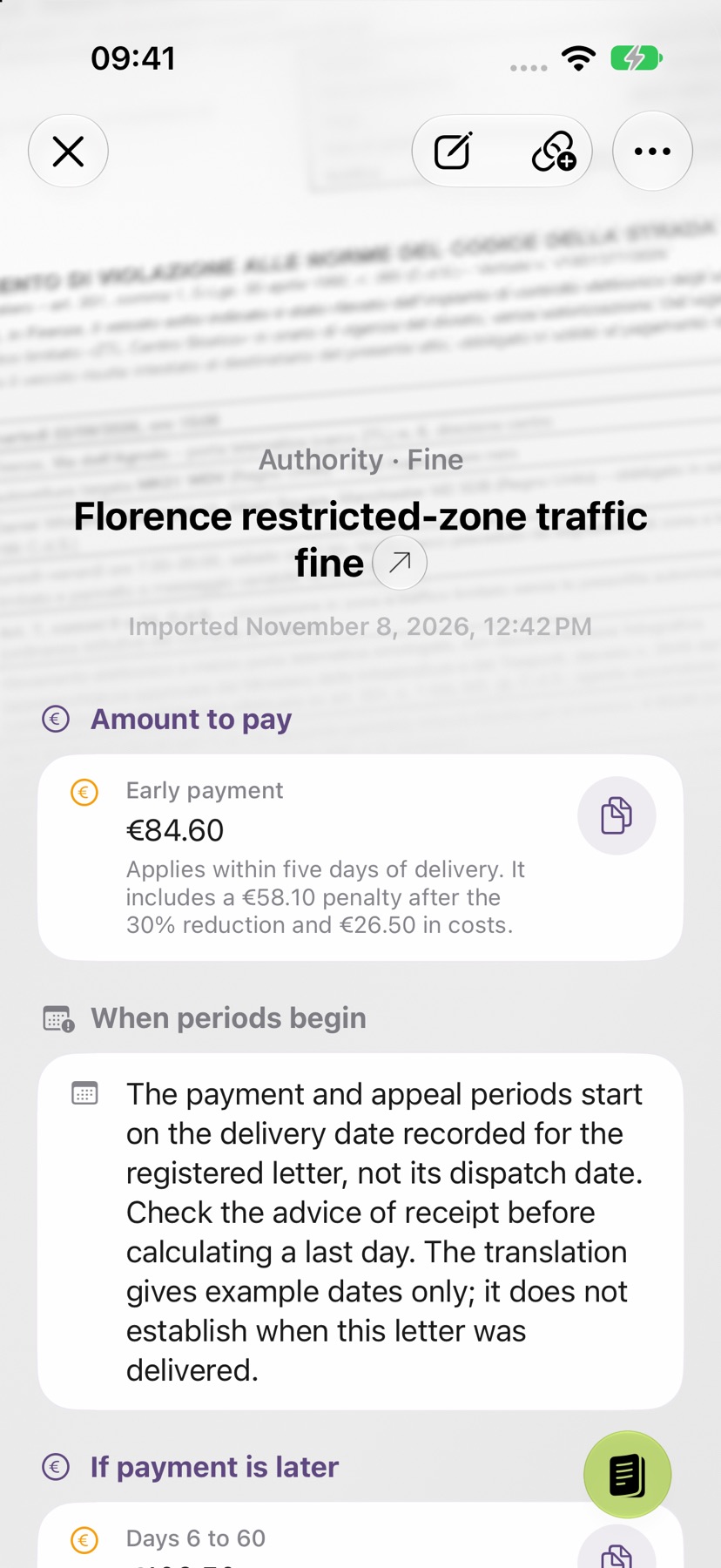
A verbale in Italian, an avis in French or a beschikking in Dutch is hard to act on if you do not read the language, and the deadline runs anyway. Tap “Scan” in ExplainThisDoc and capture every page of the letter, including the reply form, or add a PDF with “Import file” and a photo with “Import photo”. Text recognition runs on your iPhone. The Pro explanation puts the letter into English: the accusation, place and time, the amount, the discount period, how to appeal and where to pay. One Pro analysis uses one credit. The free Light analysis runs with Apple Intelligence on supported devices and in supported languages.
Pro also points out possible warning signs, such as a very short deadline or an unusual way to pay. They are hints, not proof of authenticity, and a letter without warnings is not proven genuine, so the independent check under “Is it real?” still applies.
Link the fine in your archive to your rental contract, the rental company’s e-mail and your proof of payment, and add a note with whom you called and when. If a reminder, a collection letter or a BfJ hearing letter follows, a search for the title, summary or your note brings the file back. The explanation is not legal advice; whether the fine is justified is decided in the issuing country’s procedure.
Have your traffic fine from abroad analyzed for warning signs
Snap or import
Scan the letter or import a photo or PDF. Links and QR codes in the letter are not opened.
Analyze for warning signs
Pro checks the text for typical scam signs such as time pressure, threats or requests to enter login or payment details, and shows a security notice at the top if it suspects fraud. 1 credit per analysis.
Keep it in case something follows
Original, analysis and your notes stay together in your archive; a red shield marks suspicious documents.
- No sign-up
- No subscription
- Start right away

 Scan with your iPhone camera