 ExplainThisDoc
Blood test abbreviations: what Hb, MCV, CRP and ALT mean
Your blood test report lists short codes like Hb, MCV, CRP or GGT, followed by numbers, units and sometimes an H or L. These tables explain the common abbreviations in plain words: which value is meant and what it describes. They deliberately leave out normal values in numbers, because what counts is the reference range your lab prints next to each result.
How a blood test report is laid out
Each line usually follows the same pattern: the name or abbreviation of the test, your result, the unit and the reference range. Some labs add a column for flags and your previous result.
- Panels: results are often grouped. In the UK you'll see FBC (full blood count), U&E (urea and electrolytes) and LFTs (liver function tests); in the US, CBC (complete blood count), BMP or CMP (basic or comprehensive metabolic panel) and a lipid panel.
- Units: the same value can come in different units. The UK reports glucose in mmol/L and HbA1c in mmol/mol, the US in mg/dL and percent. Only compare results with the same unit.
- Reference range: the range in which most healthy people's results fall, usually the middle 95 percent of a healthy reference group (Liver UK on reference ranges). It depends on the lab, the method, your age and often your sex.
- Flags: H marks a result above the range and L one below it; some labs use arrows, an asterisk or color instead. HH or LL can mark a critical result. Check the legend on your report.
Blood count (FBC or CBC)
The blood count measures the cells in your blood and describes the red blood cells in more detail. The differential splits the white blood cells into their types.
| Abbreviation | Stands for | What it describes |
|---|---|---|
| WBC | White blood cells (leukocytes) | Cells of the immune system |
| RBC | Red blood cells (erythrocytes) | Cells that carry oxygen |
| Hb, Hgb | Hemoglobin | The red pigment in red blood cells that binds oxygen |
| Hct | Hematocrit | The share of blood volume made up of cells |
| MCV | Mean corpuscular volume | The average size of your red blood cells |
| MCH | Mean corpuscular hemoglobin | How much hemoglobin one red blood cell contains on average |
| MCHC | Mean corpuscular hemoglobin concentration | Hemoglobin relative to the size of the red blood cells |
| RDW | Red cell distribution width | How much the size of your red blood cells varies |
| PLT | Platelets (thrombocytes) | Cell fragments that help blood clot |
| MPV | Mean platelet volume | The average size of your platelets |
| Retic | Reticulocytes | Young red blood cells; show how many are being made |
| Neut, Lymph, Mono, Eos, Baso | Neutrophils, lymphocytes, monocytes, eosinophils, basophils | Types of white blood cells in the differential, given as a percentage or an absolute count |
Inflammation, liver, kidney and pancreas
These results often appear on the same report as the blood count. Liver and kidney values are also checked as part of a general check-up, before a treatment or with regular medication.
| Abbreviation | Stands for | What it describes |
|---|---|---|
| CRP | C-reactive protein | A protein that rises with inflammation and infection |
| ESR | Erythrocyte sedimentation rate | How fast red blood cells settle; a non-specific sign of inflammation |
| ALT | Alanine aminotransferase | An enzyme found mainly in liver cells |
| AST | Aspartate aminotransferase | An enzyme from liver, heart and muscle cells |
| GGT | Gamma-glutamyl transferase | An enzyme from the liver and bile ducts |
| ALP | Alkaline phosphatase | An enzyme from the liver, bile ducts and bones |
| Bili | Bilirubin | A breakdown product of hemoglobin, cleared by the liver |
| Creat | Creatinine | A waste product from muscles; shows how well the kidneys filter |
| eGFR | Estimated glomerular filtration rate | Kidney filtering capacity, calculated from creatinine, age and sex |
| Urea, BUN | Urea (UK) or blood urea nitrogen (US) | A waste product from protein, cleared by the kidneys |
| Urate | Uric acid | A breakdown product of certain cell building blocks (purines) |
| Lipase | Lipase | A digestive enzyme from the pancreas |
Sugar, fats, thyroid, iron and clotting
Some of these values depend strongly on when the blood was taken. Glucose and triglycerides change after eating, which is why you may be asked to fast.
| Abbreviation | Stands for | What it describes |
|---|---|---|
| Glucose | Blood sugar | Sugar in your blood at the time of the test; fasting or not makes a difference |
| HbA1c | Glycated hemoglobin | Your average blood sugar over roughly the last two to three months |
| TC | Total cholesterol | All cholesterol fractions in the blood together |
| LDL | LDL cholesterol | Cholesterol carried to tissues and vessel walls |
| HDL | HDL cholesterol | Cholesterol carried back to the liver |
| TG | Triglycerides | Blood fats, strongly affected by your last meal |
| TSH | Thyroid-stimulating hormone | The pituitary hormone that steers the thyroid |
| Free T4, free T3 | Free thyroxine, free triiodothyronine | Thyroid hormones circulating freely in the blood |
| Ferritin | Ferritin | Iron storage protein; shows your iron reserves |
| Fe | Iron | Iron in the blood at the time of the test |
| TSAT | Transferrin saturation | How much of the iron transport protein is loaded with iron |
| Na, K, Ca, Mg | Sodium, potassium, calcium, magnesium | Minerals (electrolytes) for nerves, muscles and fluid balance |
| B12 | Vitamin B12 (cobalamin) | Vitamin needed for blood formation and nerves |
| 25-OH vitamin D | 25-hydroxyvitamin D | The storage form of vitamin D in the blood |
| PT, INR | Prothrombin time, international normalized ratio | How fast blood clots; the INR is comparable between labs |
| APTT | Activated partial thromboplastin time | Another clotting test covering a different part of clotting |
What a flagged result means and what it doesn't
Because the reference range covers only the middle 95 percent of healthy people, about one in twenty healthy people falls outside it on any single test. The more tests are run, the more likely one flag turns up without anything being wrong.
- Patterns: results mean more together, for example low hemoglobin with low ferritin and a small MCV.
- Trends: a clear change since your last test often says more than one measurement.
- Circumstances: food, exercise, infections, medication or pregnancy can shift results.
Interpreting them is up to your doctor, who knows your symptoms, history and earlier results. If something is unclear, ask the practice instead of waiting for your next appointment. With acute symptoms, contact urgent care or, in an emergency, call the emergency number.
Get your own report explained
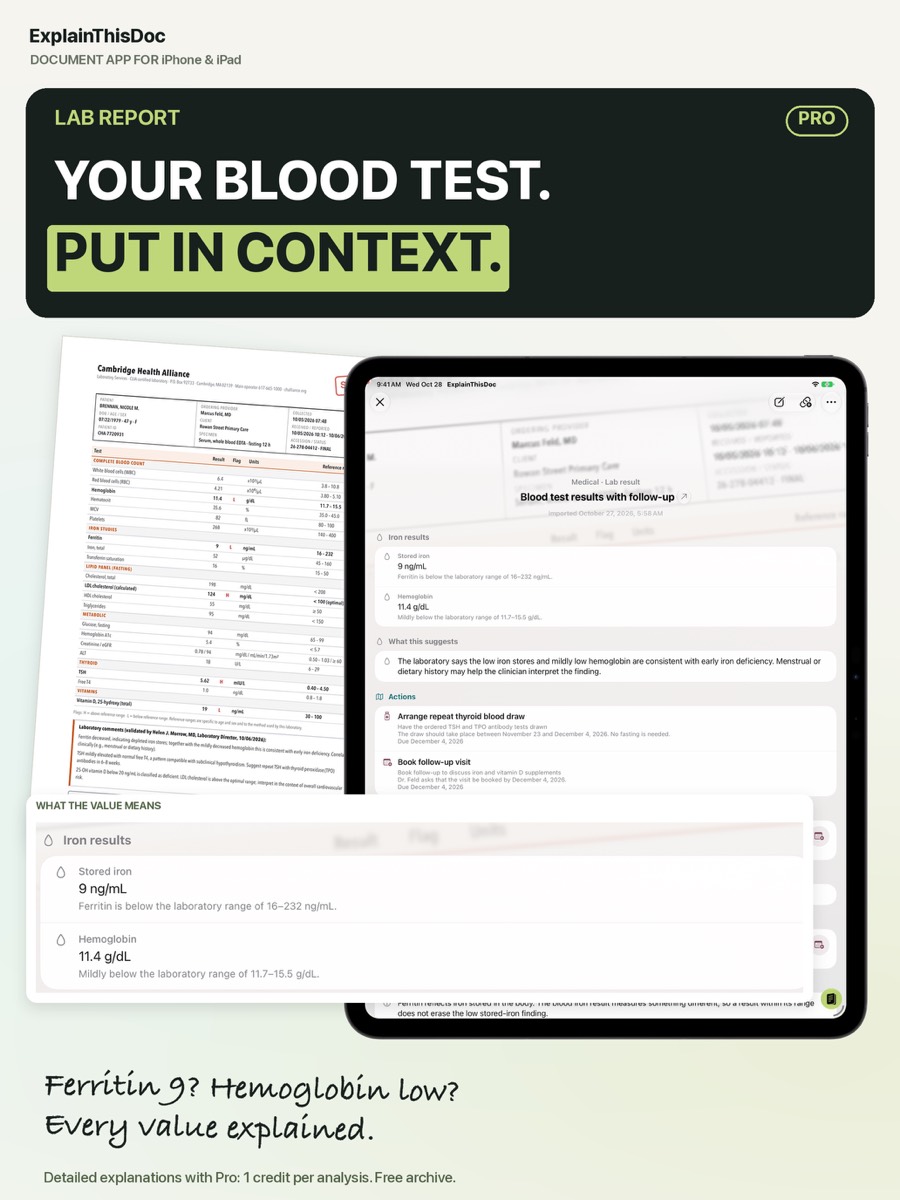
Scan your report with ExplainThisDoc or import the PDF from your patient portal. The Pro explanation goes through it value by value: what each test measures, whether it is flagged and what the lab's comment says. The free Light analysis gives you a first overview; it runs with Apple Intelligence on supported devices and in supported languages. The explanation helps you understand, but it is not a diagnosis and doesn't replace talking to your doctor.
Search your archive for “lab” to find earlier reports for comparison, and note your questions right on the report so you have them ready at your appointment. More on reading the whole report is in the guide Understand blood test results.
Get your blood test explained
Snap or import
Scan a document or bring in a photo or PDF. No sign-up, no folders.
Understand it in plain words
Light analysis, free on your device¹. In depth with Pro: 1 credit per analysis.
Find it when you need it
The original, the explanation and your notes stay together in your archive.
- No sign-up
- No subscription
- Start right away

 Scan with your iPhone camera
¹ With Apple Intelligence enabled on a supported device and in a supported language.